
SAN FRANCISCO, July 13 — For anyone who has ever tried to solve a maze by checking every single path one at a time, quantum computing offers a tantalising alternative: what if you could explore every possible route simultaneously? That, in plain terms, is the promise of the qubit. The qubit — short for quantum bit — is the fundamental building block of quantum computers, and it works nothing like the bits in your laptop or phone.
A classical bit is either a 0 or a 1, period. A qubit, by contrast, can exist in a state called superposition, where it is simultaneously 0 and 1 at the same time.
How it works
That is only half the story. Quantum computing also relies on a second principle called entanglement. When qubits become entangled, the state of one instantly influences the state of another, even if they are physically separated by a significant distance.
This linked behaviour lets quantum computers process enormous numbers of possibilities in parallel — a feat that would take classical computers an impractical amount of time. The practical upshot?
Problems that are currently intractable — simulating complex molecules for drug discovery, optimising global supply chains, cracking certain kinds of encryption — become theoretically solvable.
A brief history, and where we are now
The first qubit was demonstrated in 1995 by David Wineland and his team at the National Institute of Standards and Technology (NIST), using trapped ions. That was nearly three decades ago. Today, the largest quantum processors have reached 1,121 qubits — that is IBM’s Condor chip, announced as of 2024.
But here is the catch: qubits are fragile. They are highly prone to errors caused by environmental noise — vibrations, heat, electromagnetic interference.
This fragility leads to a phenomenon called quantum decoherence, which limits the useful computation time to just a few microseconds. In other words, you have a vanishingly small window to perform calculations before the quantum state collapses. To work around this, researchers use error correction codes, such as the surface code.
The trade-off is steep: it takes many physical qubits to create a single logical qubit that can actually perform reliable work. So while 1,121 qubits sounds impressive, the number of error-corrected, usable qubits is far smaller.
Different approaches, same goal
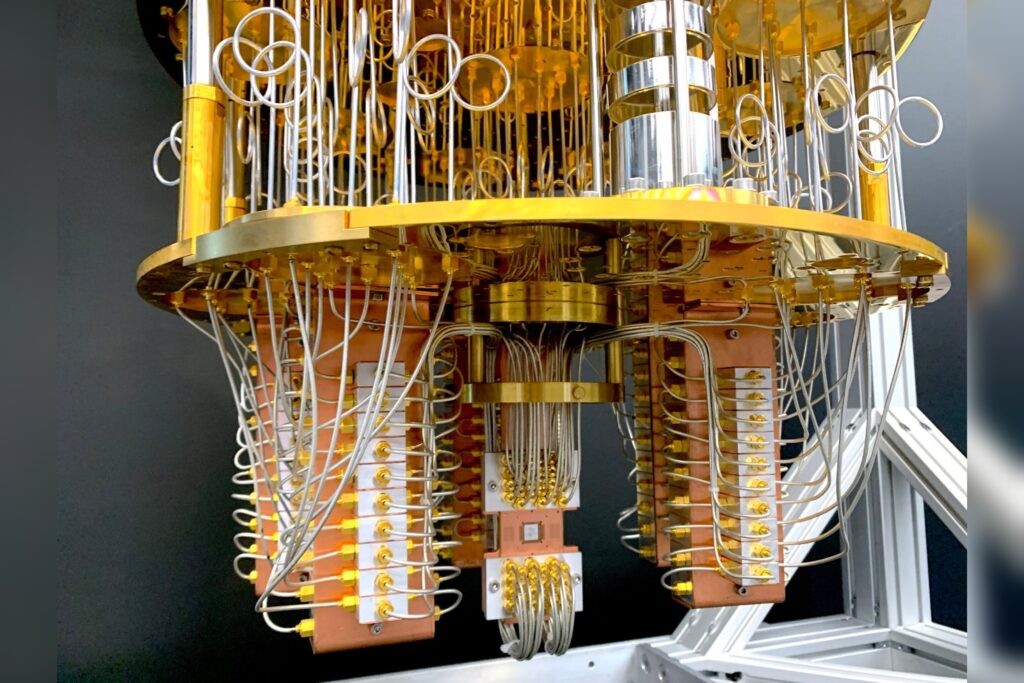
There is no single way to build a qubit. Researchers are pursuing several competing technologies, each with its own strengths and challenges. Superconducting circuits are the approach used by IBM and Google.
Trapped ions are the method favoured by IonQ and Honeywell. Photonic qubits, which use particles of light, are the focus of PsiQuantum.
And topological qubits, a more exotic and theoretically more stable design, are being pursued by Microsoft. Each approach has its own timeline and technical hurdles. The field is still very much in its experimental phase, with no clear winner yet.
What to watch next
The race is now about scale and stability. The key question is not just how many qubits you can fit on a chip, but how many of them can be made to work reliably together long enough to outperform a classical computer on a real-world problem. Error correction, materials science, and cryogenic engineering are all moving in parallel.
For the ordinary reader, the takeaway is this: quantum computing is not a near-term replacement for your smartphone or laptop. It is a fundamentally different kind of machine, aimed at a different class of problems.
The qubit is the engine, but we are still learning how to drive it.
Sources
{“@context”: “https://schema.org”, “@type”: “NewsArticle”, “headline”: “Quantum Computing: Superposition, Entanglement, and Qubits Explained”, “description”: “SAN FRANCISCO, July 13 — For anyone who has ever tried to solve a maze by checking every single path one at a time, quantum…”, “datePublished”: “2026-07-13T09:30:00+00:00”, “author”: {“@type”: “Person”, “name”: “Erika Johnson”}, “publisher”: {“@type”: “Organization”, “name”: “InfoPulse Today”, “url”: “https://newsfeed.infopulsetoday.com/”}, “citation”: [{“@type”: “CreativeWork”, “url”: “https://en.wikipedia.org/wiki/Qubit”}]}




