
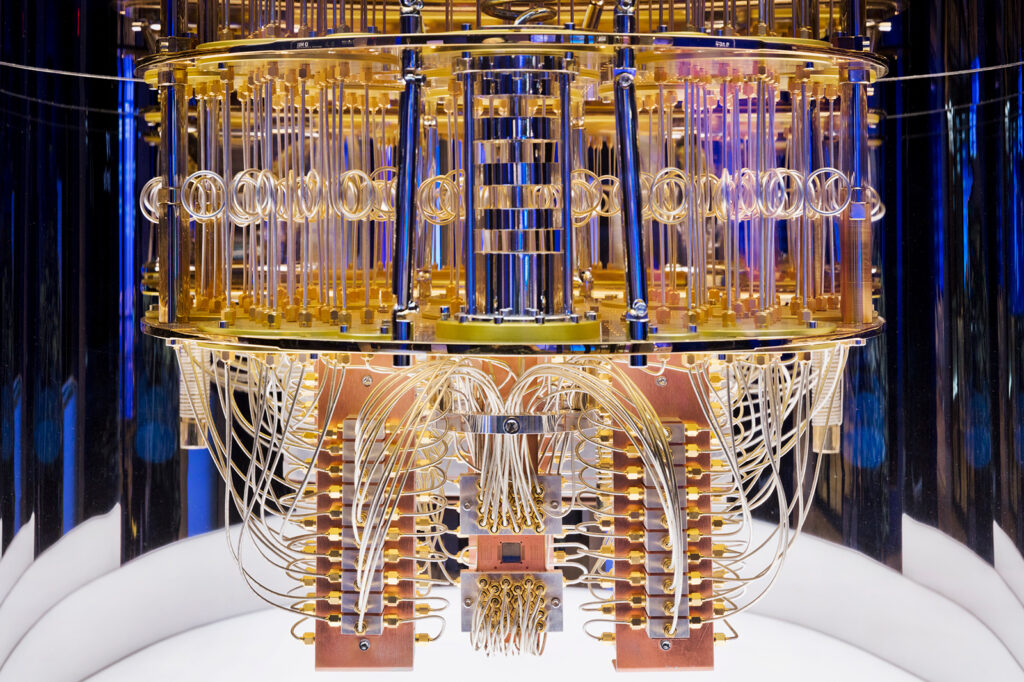
NEW YORK, July 13 — For decades, the promise of quantum computing has lived mostly in the realm of theory and laboratory experiments. But a quiet revolution is underway, and the people who will feel its effects first might not be physicists in white coats, but patients waiting for a new drug, or engineers trying to design a better battery. The basic idea is a radical departure from the computers we use today.
Classical machines process information in bits, each one a strict zero or a one. Quantum computers use qubits, which harness quantum-mechanical phenomena like superposition and entanglement to exist in multiple states at once.
This isn’t just a faster version of the same thing — it is a fundamentally different way of calculating, one that opens the door to solving problems that would take a classical computer longer than the age of the universe.
From a physicist’s thought experiment to a working machine
The intellectual foundation was laid decades ago. In 1981, the physicist Richard Feynman first proposed the idea of a quantum computer. Then, in 1994, Peter Shor published an algorithm for factoring large numbers, a breakthrough that sent a shockwave through the world of cryptography because it threatened the security of the widely used RSA encryption standard.
By the late 1990s, researchers had demonstrated the first experimental quantum gates, proving the concept could work in practice. Today, the race is no longer academic.
Major players including IBM, Google, Microsoft, and the company IonQ are all pushing the technology forward. The most dramatic public milestone came in 2019, when Google announced that its Sycamore processor had achieved what the field calls ‘quantum supremacy.’ The machine solved a specific, highly specialized problem in 200 seconds — a task that, according to Google, would have taken the world’s most powerful classical supercomputer 10,000 years to complete. The claim was met with both celebration and skepticism from rivals, but it marked a clear turning point.
Where the technology stands now
As of 2025, the most advanced quantum processors have reached up to 1,000 qubits. That number sounds impressive, but the reality is more complicated. Error correction remains a formidable challenge.
Qubits are fragile; they are easily disturbed by heat, electromagnetic radiation, and other environmental noise. Building a machine that can perform reliable, large-scale calculations will require not just more qubits, but far better ways to protect and correct the information they carry.
The potential payoff is enormous enough that governments and corporations are pouring money into the effort. The global quantum computing market was valued at $866 million in 2023, and projections estimate it will grow to $6.5 billion by 2030. That kind of investment reflects a clear belief that the technical hurdles will be overcome.
What it means for the world beyond the lab
For the people who will benefit most, the science matters less than the results. In drug discovery, a quantum computer could simulate molecular interactions at a level of detail that is impossible for classical machines, potentially cutting years off the time it takes to bring a new medicine to market. In materials science, researchers could design new compounds with specific properties — stronger alloys, more efficient solar panels, lighter aircraft components — by modeling their behavior at the quantum level.
Cryptography faces both a threat and an opportunity: the same power that could break existing encryption schemes could also create new, unbreakable ones. And in optimization, from supply chain logistics to financial portfolio management, quantum algorithms could find better solutions to problems that have too many variables for classical computers to handle.
The next few years will determine whether quantum computing moves from a promising experiment to a practical tool. The pieces are in place: the theoretical foundation, the corporate competition, the market momentum, and the first proof that the machines can outperform classical ones on at least some tasks. The question is no longer whether quantum computers will work.
It is how soon they will work well enough to change the world.
Sources
{“@context”: “https://schema.org”, “@type”: “NewsArticle”, “headline”: “Quantum Computing: Superposition & Entanglement Could Revolutionize Tech”, “description”: “NEW YORK, July 13 — For decades, the promise of quantum computing has lived mostly in the realm of theory and laboratory experiments. But a…”, “datePublished”: “2026-07-13T09:30:00+00:00”, “author”: {“@type”: “Person”, “name”: “James Roberto”}, “publisher”: {“@type”: “Organization”, “name”: “InfoPulse Today”, “url”: “https://newsfeed.infopulsetoday.com/”}, “citation”: [{“@type”: “CreativeWork”, “url”: “https://en.wikipedia.org/wiki/Quantum_computing”}]}




